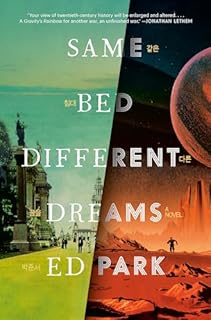
Same Bed Different Dreams: A Novel by Amazonundefined
- • Długość
- • Język
- • Data publikacji
- • Wymiary
Description
Editors Choice A wild, sweeping novel that imagines an alternate secret history of Korea and the traces it leaves on the presentloaded with assassins and mad poets, RPGs and slasher films, pop bands and the perils of social mediaYour view of twentieth-century history will be enlarged and altered. . . . A
Gravitys Rainbow
for another war, an unfinished war. Jonathan Lethem, author of
The Fortress of Solitude
ONE OF
PUBLISHERS WEEKLY
S TEN BEST BOOKS OF THE YEAR FINALIST FOR THE
LOS ANGELES TIMES
BOOK PRIZEA BEST BOOK OF THE YEAR:
The New York Times Book Review, The Washington Post, Los Angeles Times,
Chicago Public Library,
Polygon, Kirkus Reviews
In 1919, far-flung patriots establish the Korean Provisional Government to protest the Japanese occupation of their country. This government-in-exile proves mostly symbolic, though, and after Japans defeat in World War II, the KPG dissolves and civil war erupts, resulting in the tragic North-South split that remains today.But what if the KPG still existednow working toward a unified Korea, secretly pulling levers to further its aims?
Same Bed Different Dreams
weaves together three distinct narrative voices with an archive of mysterious images, and twists reality like a kaleidoscope. Korean history, American pop culture, and our tech-fraught lives come together in this extraordinary and unforgettable novel.Soon Sheen, a former writer now employed by the tech behemoth GLOAT, comes into possession of an unfinished book seemingly authored by the KPG. The manuscript is a riveting revisionist history, connecting famous names and obscure bit players to the KPGs grand projecteveryone from Syngman Rhee and architect-poet Yi Sang to Jack London and Marilyn Monroe.
M*A*S*H
is in here, too, as are the Moonies and a history of violence extending from the assassination of President McKinley to the Reagan-era downing of a passenger plane that puts the world on the brink of war.From the acclaimed author of
Personal Days, Same Bed Different Dreams
is a raucously funny feat of imagination and a thrilling meld of history and fiction that pulls readers into another dimensionone in which utopia is possible.
Recenzja
Genius . . .
Same Bed Different Dreams
is an extraordinaryand
hilarious
genre-busting nesting doll of comedy, science fiction, and thriller and, at its core, an epic compendium of Korean history thats also the dark history of American foreign entanglements. Its like no other novel Ive read beforea cabinet of wonders that demands to be read and reread.
Cathy Park Hong, author of
Minor Feelings
I cant stop reading, thinking, and dreaming about this feverish, mind-altering marvel of a book.
Hua Hsu, Pulitzer Prizewinning author of
Stay True
Your view of twentieth-century history will be enlarged and altered by Ed Parks mysterious, panoramic novel. It
seems to draw on Bolaño, Pynchon, and DeWitt for its radical structure, yet remains grounded in a droll, sweet voice weve wished to hear again since
Personal Days
. This is a
Gravitys Rainbow
for another war, an unfinished war. Having been enlisted in the Korean Provisional Government, I now await my instructions.
Jonathan Lethem, author of
The Fortress of Solitude
A book of dizzying scope and erudition . . . very funny, intimate, and playful and interested in basic questions of existence, beginning with: Why are we here and what gives us meaning?
Dave Eggers, author of
The Circle
A novel to get lost in and a feat of imagination . . . I read it with awe for its construction and for the sheer pleasure of its language.
Charles Yu, National Book Awardwinning author of
Interior Chinatown
Totally astounding . . .
Same Bed Different Dreams
emits a prismatic intelligence operating on multiple frequencies. I didnt know Id been waiting for a book like this until I encountered it.
Ling Ma, author of
Severance
Same Bed Different Dreams
is a kaleidoscope of Koreamericana; a crowd of cracked voices; a gorgeous, hilarious, provisional dream; a wonder.
Namwali Serpell, author of
The Furrows
No blurb could adequately praise or even sum up this novel. All I know is that
Same Bed Different Dreams
belongs in the company of a rare few dark and comic masterpieces of invention. It disarmed me with sheer delight.
Elizabeth McKenzie, author of
The Portable Veblen
Park blurs fact and fiction so seamlessly that search results will undoubtedly surprise if not shock, albeit not without reverential delight.
Booklist,
starred review
Park returns fifteen years after
Personal Days
with an ingenious postmodern epic of colonial and postcolonial Korea framed in a satire of Americas publishing and tech industries . . . This tribute to the fractured peninsulas citizens, diaspora, and allies is one for the ages.
Publishers Weekly
, starred review
O autorze
Ed Park
is the author of the novels
Personal Days
and
Same Bed Different Dreams
.
He is a founding editor of
The Believer,
and has worked in newspapers, book publishing, and academia. His writing appears in
The New Yorker, The New York Review of Books, Harpers Magazine, The Atlantic,
and elsewhere
.
Born in Buffalo, he lives in Manhattan with his family.
Fragment książki opublikowany za zgodą wydawcy. Wszelkie prawa zastrzeżone.
What is history?
That is the question, that is the job. Might a deeper understanding of history benefit the company, or is it to be avoided at all costs? Teams are told to blue-sky it, whiteboard it, list out pros and cons. When you break the word down, what does it tell you? The Latin, from the Greek.Three telegenic academics discuss it at an all-hands. The first speaker, an American wunderkind, sports a headset with a purple-foamed mic that resembles a levitating gumdrop on the jumbotron. History, she intones as she paces, from the same Indo-European root that gave us wit. She mimes tearing out and crumpling her notes, to signal Enough with the old ways. In the last decade, she says, history has toppled from the king of disciplines to a numbing data set: a litany of trackable moments, the realm of machines.She stands at the lip of the stage. Everything you buy, view, read, and believe gets recorded. Where you drive, how you sleep. Lusts and peccadilloes. Mental lapses, steps climbed. Debits and credits, search terms and activity logs. Only by going off the grid can one enter true history. Abolish every clock, she concludes. Go back to Day Zero.A concerned murmur. Is this a dig at the company and its voracious tab keeping? Or will this radical reset somehow help them do their job? The workers clap politely.Day Zero? comes a coy query, from the second historian. Hmm.Hes her former adviser. White hair, black eyebrows, with a mustache that splits the difference. Remaining seated, he offers a rambling anecdote by way of rebuttal. Early in his career, while engrossed in some eighteenth-century grain ledgers, he brooded over the meaning of history. One afternoon, sharpening a pencil, he received the answer, a metaphor that perfectly captured his calling. He wrote it down and continued his work amid those humble documents.Four years passed, as he labored on the monograph he was sure would secure his reputation. Nearly finished, he prepared the coup de grâce: his shattering insight into the true nature of history. Now, alas, the full formula eluded him. After days of searching, he located the slip of paper with the aperçu at the bottom of his satchel. To his horror, a summer storm had reduced it to a blank white scrap. The more he tried recalling the words, the less sure he was about anything.The crowd takes it all down. A cough booms through the speakers.My old friend asserts we should avoid metaphor when it comes to history, sniffs the third panelist, a cheeky maverick of indecipherable ethnicity, gender, and height. Yet the nostalgic scene he presents is itself a new metaphor, as apt and useless as all others, by his own definition. What is history, you ask? A message from a genius, ruined by the rain.For two hours, the three scholars spar, drawing on video games, mirror neurons, some minor works of Poe. They speak to be quoted, and the audience of employees sits rapt. For the most part. During the debate, someone secretly records a colleague pinching his own thighs, struggling to keep his eyes opento no avail. Soon the man is snoring. Onstage, the first scholar booms, What is history? The subject wakes with a start, slurps back some drool.The video gets forwarded, bccd, uploaded, liked. The self-pinchers face is only half visible, but the gist is clear. As the clip makes the rounds, viewers add captions, crude animations. It becomes a sort of folk tale, bristling with embellishment. It speaks to current events, pop culture, the environment. Versions leak outside the organization: jumping borders and slipping into foreign tongues. Spin-offs exist that are not safe for work. This fading, drooling figure in the crowd is part of history, too, even if the official transcript omits the incident.What is history?At least for now, its a three-way standoff, a memory of rain, a cure for insomnia. These possibilities are duly entered into the system.The Sins August The JuryFrom a distance, the black smoking station on the white pavement in front of the Admiral Yi resembled a chess piece, whether bishop or knight, I couldnt decide. The matter seemed crucial as I approached. My daughter, Story, would have an opinion, but of course she wasnt with me. She was seven, and chess figured prominently in her life. During one game, in the midst of crushing my kingside defenses, she said that the bishop was worth three points, same as a knight. (Then she put me in check.) The fact surprised me. I had reckoned bishops on par with rooks, knights a step below. Then again, the bishops were yoked to their starting colors, as though you were playing checkers. Perhaps the smoking station was just a pawn after all.Dusk hung like velvet over West Thirty-second Street, what the sign called Korea Way, though I have never heard anyone use that name. I was in the city, on a weeknight no less, a rare event for me. My family and job were upstate in Dogskill, an hour and change via Metro-North. Not so very far; still, I didnt like visiting Manhattan. It made me miss everything too much.My appearance was a solid for Tanner Slow: old college roommate, dispenser of numerous good deeds on my behalf, and main link to the life Id led years ago. Tanner had worn many hats over the years. Hed been a music journalist, fired for not liking music, and briefly a literary agenthe sold my first and only book, a story collection that I couldnt bear to look at anymore. He once ran a Tucson charity that gave bikes to the homeless, and even worked at GLOAT in the aughts, hiring me during his brief tenure. But after his father the vitamin king died and left him a zillion dollars, Tanner set up the Slow Press, devoted to his three idiosyncratic passions: political graphic novels done with woodcuts, niche cookbooks, and neglected literature in translation. Last season hed released a revisionist account of the Haymarket Riot, a set of Malaysian curry recipes that could be done using only a rice cooker, and a collection of nature essays by Ugandas E. B. White.Tonight was simple. Tonight Id meet Tanner Slows newest author, Cho Eujin, once the enfant terrible of South Korean letters. The Slow Press had signed on to bring out his oeuvre in America, and he would be a visiting lecturer at Rue University Extension Campus that fall. Tanner swore Id like him. I couldnt find a clear picture of Cho online, but in my mind he resembled my father, gone now over thirty years. Also slated to appear was the reclusive artist Mercy Pang, another camera avoider. My wife, Nora, was pretty sure shed babysat for her back in the 90s, and wanted me to take a picture so she could check.Despite the warmth of the day, I planned to lay into a tasty bowl of seolleongtang or kalguksu, down a few OBs, and say good night to one and all in my bad Korean. Id make sure not to get roped into a karaoke situation. I was already rehearsing my exit line, the one about having to catch the train back home out of Grand Central.Tonight would have been a rare treata pleasant evening with one of my oldest friends and his latest discoveryif not for all the Asian American literati who threatened to show up as well. Poets and editors and folks associated with Rue Universitys Wildword program. Id mix up peoples names. Id have nothing to say to them. I was no longer in the game.They viewed me as a traitor. My employer, GLOAT, was so vast that it almost lost definitionthey all used at least a few of its many featuresbut in their eyes, Id abandoned the life of the mind to service the Almighty Algorithm.It was true that I didnt write anymore. For a while, I kept story notes, and one summer even wrestled a novel partway out of my skull. It had proved too unwieldy, even dangerous: a hydra that spoke in tongues. I mapped out the plot on yard-high Post-its, slapped them on the walls while I wrote. Nora likened it to the handiwork of a cop trying to outguess a serial killer, or maybe the other way around.I didnt write anymore. My current fictioneering was limited to bedtime tales spun out for my daughter as a sleeping aid. They involved UFOs, her chief interest besides chess. I was good at describing alien spacecrafts zipping through the clouds and the capture of curious Earthlings with a tractor beam. Once the quarry got on board, though, I went into numbing detail about the layout of the control room, lulling Story to dreamland.I didnt write anymore. My last jab at literary journalism had been years ago, for the late lamented Lament, which had since gone from elegant bimonthly to wisp of a quarterly to dysfunctional website, before disappearing completely. Clean Sheets was a jeu desprit about the titles Id salvaged, to Noras dismay, from the basement laundry rooms of apartments where we used to live. The essay posited that these castoff librariesself-help tomes, mouse-munched thrillers, hiking guides in foreign languagestold a buildings secret history. It was my love letter to the city; right before it came out, we moved to Dogskill. When the issue arrived, I put it directly into the recycling bin. On Friday morning I wheeled the bin to the curb, where at 9:13 a truck with a robot arm held it aloft, turned it over to release the empty bottles and printed matter, then replaced it before driving off: the quintessential suburban port de bras.
Czytaj więcej
Product information
- Wydawca:Random House
- ISBN-10:0812998979
- ISBN-13:978-0812998979
- Author:Ed Park
Related products to Same Bed Different Dreams: A Novel:

Explore other categories
Other products from Literatura światowa: