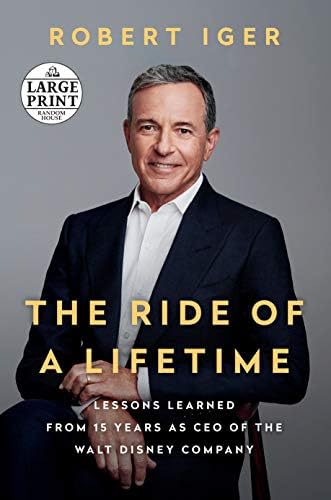

The Ride of a Lifetime: Lessons Learned from 15 Years as CEO of the Walt Disney Company by Amazonundefined
Description
NEW YORK TIMES
BESTSELLER
A memoir of leadership and success
: The CEO of Disney shares the ideas and values he embraced
while reinventing one of the worlds most beloved companies
and inspiring the people who bring the magic to life.
AN NPR BEST BOOK OF THE YEAR
Robert Iger became CEO of The Walt Disney Company in 2005, during a difficult time. Competition was more intense than ever and technology was changing faster than at any time in the companys history. His vision came down to three clear ideas: Recommit to the concept that quality matters, embrace technology instead of fighting it, and think biggerthink globaland turn Disney into a stronger brand in international markets. Today, Disney is the largest, most admired media company in the world, counting Pixar, Marvel, Lucasfilm, and 21st Century Fox among its properties. Under Igers leadership, Disneys value grew nearly five times what it was, making Iger one of the most innovating and successful CEOs of our era.In
The Ride of a Lifetime
, Robert Iger shares the lessons he learned while running Disney and leading its 220,000-plus employees, and he explores the principles that are necessary for true leadership, including:
Optimism.
Even in the face of difficulty, an optimistic leader will find the path toward the best possible outcome and focus on that, rather than give in to pessimism and blaming.
Courage.
Leaders have to be willing to take risks and place big bets. Fear of failure destroys creativity.
Decisiveness.
All decisions, no matter how difficult, can be made on a timely basis. Indecisiveness is both wasteful and destructive to morale.
Fairness.
Treat people decently, with empathy, and be accessible to them. This book is about the relentless curiosity that has driven Iger since the day he started as the lowliest studio grunt at ABC. Its also about thoughtfulness and respect, and a decency-over-dollars approach that has become the bedrock of every project and partnership Iger pursues, from a deep friendship with Steve Jobs in his final years to an abiding love of the
Star Wars
mythology. The ideas in this book strike me as universal Iger writes. Not just to the aspiring CEOs of the world, but to anyone wanting to feel less fearful, more confidently
themselves,
as they navigate their professional and even personal lives.
Recenzja
I expected a book written by the person who has led Disney for decades to be defined by both gripping storytelling and deep leadership wisdom. Bob Iger delivers, and then some!
The Ride of a Lifetime
is leadership goldyou wont forget the stories or the lessons.
Brené Brown, #1
New York Times
bestselling author of
Dare to Lead
Nurturing creativity is less a skill than an artespecially at a company where the brand alone is synonymous with creativity. Thats a lot to live up to. Bob Iger has not only lived up to ninety-six years of groundbreaking history but has moved the Disney brand far beyond anyones expectations, and he has done it with grace and audacity. This book shows you how thats happened.
Steven Spielberg
People have been waiting years for Bob Iger to share his leadership secrets. Now he has, and they are utterly brilliant.
The Ride of a Lifetime
is not merely a memoir; its a personal, all-access session with the wisest CEO youve ever met and a playbook for handling the key challenges of our age: how to drive change, leverage technology, build an enduring culture, and empower people. Its a rippingly good, revelatory read.
Daniel Coyle,
New York
Times
bestselling author of
The Culture Code
O autorze
Robert Iger
is the CEO of The Walt Disney Company and directs the companys creative endeavors. He served as CEO from 2005 to 2020 and as executive chairman from 2020 to 2022. He previously was president and COO from 2000 to 2005. Iger began his career at ABC in 1974, and as chairman of the ABC Group he oversaw the broadcast television network and station group, managed the cable television properties, and guided the merger between Capital Cities/ABC, Inc., and The Walt Disney Company. Iger officially joined the Disney senior management team in 1996 as chairman of the Disney-owned ABC Group and in 1999 was given the additional responsibility of president, Walt Disney International. In that role, Iger expanded Disneys presence outside of the United States, establishing the blueprint for the companys international growth today. In 2023, he was named one of
Time
s 100 Most Influential People of the Year.
Fragment książki opublikowany za zgodą wydawcy. Wszelkie prawa zastrzeżone.
Chapter 1Starting at the BottomThis book is not a memoir, but its impossible to talk about the traits that have served me well over the course of my professional life and not look back at my childhood. There are certain ways Ive always been, things Ive always done, that are the result of some inscrutable mix of nature and nurture. (Ive always woken early, for example, as far back as I can remember, and cherished those hours to myself before the rest of the world wakes up.) There are other qualities and habits that are the result of purposeful decisions I made along the path. As is the case with many of us, those decisions were partially made in response to my parents, in particular my father, a brilliant and troubled man who shaped me more than anyone.My father made me curious about the world. We had a den lined with shelves full of books, and my dad had read every one of them. I didnt become a serious reader until I was in high school, but when I did finally fall in love with books, it was because of him. He had complete sets that he ordered from the Book of the Month Club of the works of all the American literary giantsFitzgerald and Hemingway and Faulkner and Steinbeck and so on. Id pull down from the shelves his copy of Tender Is the Night or For Whom the Bell Tolls or dozens of others and devour them, and hed urge me to read even more. We also spent our dinners discussing world events, and as young as ten years old, Id grab the New York Times on our front lawn and read it at the kitchen table before anyone else woke up.We lived in a split-level house in a small working-class town on Long Island called Oceanside. I was the older of two kids; my sister is three years younger. My mother was warm and loving, a stay-at-home mom until I went to high school, at which point she got a job in the local junior high school library. My dad was a Navy veteran who came back from the war and played the trumpet with some lesser big bands, but he figured he could never make much of a living as a musician, so never tried to do it full-time. He majored in marketing at the University of Pennsylvanias Wharton School, and his first job was working in marketing for a food manufacturing company, and that led him into advertising. He became an account executive at an advertising agency on Madison Avenuehe handled the Old Milwaukee and Brunswick bowling accountsbut eventually lost that job. He changed agencies several times, almost always lateral moves. By the time I was ten or eleven, hed changed jobs so many times that I began to wonder why.He was always deeply politically engaged and had a very strong liberal bias. He once lost a job because he was determined to go to the March on Washington and see Martin Luther King, Jr., speak. His boss wouldnt give him the day off, but he went anyway. I dont know if he quit and went to the speech or if he was fired for going after hed been told he couldnt, but it was just one of several such endings.I was proud of his strong character and his politics. He had a fierce sense of what was right and fair, and he was always on the side of the underdog. But he also had trouble regulating his moods and would often say things that got him into trouble. I later learned that hed been diagnosed with manic depression, and that hed tried several therapies, including electroshock therapy, to treat his illness. As the older child, I bore the brunt of his emotional unpredictability. I never felt threatened by his moods, but I was acutely aware of his dark side and felt sad for him. We never knew which Dad was coming home at night, and I can distinctly recall sitting in my room on the second floor of our house, knowing by the sound of the way he opened and shut the door and walked up the steps whether it was happy or sad Dad. He would sometimes check in on his way past my room to make sure I was spending time productively, as he put it. That meant reading or doing homework or being engaged in something that would better me in some way. He wanted my sister and me to have fun, but it also was very important to him that we use our time wisely and work in a focused way toward our goals. Im certain that my vigilance (some might say obsessiveness) about time-management comes from him. The extent to which I tend to be emotionally consistent with the people in my life, or dependable in a crisis, comes from him, too. My sister and I were never deprived of love as kids, but we were deprived of consistency. I felt early on that it was my job to be the steady center of our family, which extended even to practical matters around the house. If something broke, my mother would ask me to fix it, and I learned as a young kid how to repair whatever needed repairing. Thats part of where my curiosity about technology comes from, too, I think. I liked using tools and taking things apart and understanding how they worked.My parents were worriers. There was a sense with both of them that something bad would soon be coming down the pike. I dont know how much of it is a fluke of genetics and how much is a learned reaction to their anxiety, but Ive always been the opposite of that. With few exceptions in my life, Ive never worried too much about the future, and Ive never had too much fear about trying something and failing.As I grew older, I became more aware of my fathers disappointment in himself. Hed led a life that was unsatisfying to him and was a failure in his own eyes. Its part of why he pushed us to work so hard and be productive, so that we might be successful in a way that he never was. His employment troubles necessitated that I find jobs if I wanted to have any spending money, and I started working in eighth grade, shoveling snow and babysitting and working as a stock boy in a hardware store. At fifteen, I got a job as the summer janitor in my school district. It involved cleaning every heater in every classroom, then moving on to the bottom of every desk, making sure they were gum-free when the school year started. Cleaning gum from the bottoms of a thousand desks can build character, or at least a tolerance for monotony, or something . . . .I attended Ithaca College and spent nearly every weekend night my freshman and sophomore year making pizza at the local Pizza Hut. I got mostly Bs and a few As in high school, but academics was never my passion. Something clicked for me when I went to college, though. I was determined to work hard and learn as much as I could learn, and I think that, too, was related to my fathera function of both my admiration for how learned he was and a growing feeling that I never wanted to experience the same sense of failure that he felt about himself. I didnt have a clear idea of what success meant, no specific vision of being wealthy or powerful, but I was determined not to live a life of disappointment. Whatever shape my life took, I told myself, there wasnt a chance in the world that I was going to toil in frustration and lack of fulfillment.I dont carry much pain with me from those early years, other than the pain that my dad didnt live a happier life, and that my mother suffered, too, as a result. I wish he could have felt prouder of himself. We always had a roof over our heads and food on the table, but there was little money for much else. Vacations were usually spent driving to mundane places in our car or going to the beach a few minutes away from our house. We had enough clothes to look presentable, but nothing extra, and when I tore a pair of pants in the fall, I was typically told to wear them with a patch until we had the money to replace them, which could be months. I never felt poor, and no one viewed me as such. Things were a lot thinner than they looked, though, and as I grew older I became aware of that.Late in life, after Id become CEO of Disney, I took my father to lunch in New York. We talked about his mental health and his perspective on his life. I told him how much I appreciated everything that he and my mom had done for us, the ethics they instilled, and the love they gave us. I told him that was enough, more than enough, and wished that my gratitude might liberate him in some small way from disappointment. I do know that so many of the traits that served me well in my career started with him. I hope that he understood that, too.I started my career at ABC on July 1, 1974, as a studio supervisor for ABC Television. Before that, Id spent a year as a weatherman and feature news reporter at a tiny cable TV station in Ithaca, New York. That year of toiling in obscurity (and performing with mediocrity) convinced me to abandon the dream Id had since I was fifteen years old: to be a network news anchorman. Im only half-joking when I say that the experience of giving the people of Ithaca their daily weather report taught me a necessary skill, which is the ability to deliver bad news. For roughly six months of the year, the long bleak stretch from October through April, I was far from the most popular guy in town.I came to ABC thanks to my uncle Bobs bad eyesight. My mothers brother, whom I adored, spent a few days in a Manhattan hospital after eye surgery, and his roommate was a lower-level ABC executive, who for whatever reasons wanted my uncle to believe he was a big network mogul. He would fake taking phone calls in his hospital bed, as if there were important network decisions that only he could make, and my uncle fell for it. Before he was discharged, my uncle mentioned to his roommate that his nephew was looking for a job in television production in New York. The guy gave him his number and said, Tell your nephew to give me a call.He was surprised and a little confused about who I was when I actually followed through. Based on what my uncle had described, I was expecting a powerful network executive whose influence was felt at the highest reaches of the company. He was far from that, but to his credit, he did manage to get me an interview in the small department he ran at the network, Production Services, and not long after that I was hired on as a studio supervisor.The position paid $150 per week and was about as low as you could go on the ABC ladder. There were a half dozen of us who did all manner of menial labor, on game shows and soap operas and talk shows and news shows and made-for-TV specialsbasically anything produced at ABCs sprawling Manhattan studios. I was assigned to a whole gamut of programming: All My Children and One Life to Live and Ryans Hope, The $10,000 Pyramid and The Money Maze and Showdown. The Dick Cavett Show. Geraldo Riveras Good Night America. The ABC Evening News with Harry Reasoner.The job description was pretty simple: Show up whenever they needed me, for whatever task. Often that meant being at a studio at 4:30 a.m. for lighting calls. Soap opera sets were set up the night before a shoot, and my job was to let in the lighting director and stagehands long before the sun came up, so the lights would be in place when the director and actors arrived for their first run-throughs. I coordinated all the carpenters and prop masters and electricians, makeup artists and costume people and hairstylists, checking everybody in and making sure they had their marching orders for the day. I kept track of their hours and their grievances and their violations of union rules. I made sure catering was in place and the air-conditioning had cooled the studios enough to begin shooting under the hot lights. It was the opposite of glamorous, but I learned the ins and outs of all of those shows. I spoke the lingo. I got to know all of the people who made a TV show work. Maybe most important, I learned to tolerate the demanding hours and the extreme workload of television production, and that work ethic has stayed with me ever since.To this day, I wake nearly every morning at four-fifteen, though now I do it for selfish reasons: to have time to think and read and exercise before the demands of the day take over. Those hours arent for everyone, but however you find the time, its vital to create space in each day to let your thoughts wander beyond your immediate job responsibilities, to turn things over in your mind in a less pressured, more creative way than is possible once the daily triage kicks in. Ive come to cherish that time alone each morning, and am certain Id be less productive and less creative in my work if I didnt also spend those first hours away from the emails and text messages and phone calls that require so much attention as the day goes on.It was a very different industry back then. In some ways it was better. The competition was simpler, the world less atomized. Certainly there was a mostly shared American narrative, organized around a general societal belief in basic facts. In many other ways, though, it was worse. For one, there was a shrugging tolerance of a level of disrespect that would be unacceptable today. It was without a doubt much more difficult on a day-to-day basis for women and members of underrepresented groups than it ever was for me. But even in my case, being low on the food chain meant exposure to the occasional, casual abuse that people would be fired for now.One example that captures so much of that time: The Evening News was broadcast at 6:00 p.m. Eastern Standard Time. The moment we wrapped, the anchorman Harry Reasoner and his stage manager, a man called Whitey, would walk off the set and park themselves at the bar of the Hotel des Artistes on West Sixty-seventh Street. (The Evening News was broadcast from a converted ballroom in the old hotel.) Every evening, Harry would down a double extra-dry Beefeater Martini on the rocks with a twist.
Czytaj więcej
Product information
- Długość wersji drukowanej:400 str.
- Język:Angielski
- Wydawca:Random House Large Print
- Data publikacji:1 października 2019
- Wymiary:15.47 x 2.59 x 23.32 cm
- ISBN-10:0593170989
- ISBN-13:978-0593170984
- Author:Robert Iger
Related products to The Ride of a Lifetime: Lessons Learned from 15 Years as CEO of the Walt Disney Company:


Explore other categories
Other products from Filmy: