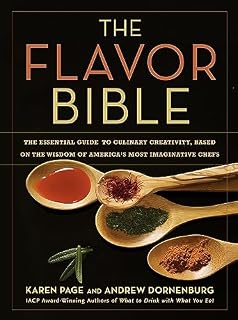
The Flavor Bible /anglais: The Essential Guide to Culinary Creativity, Based on the Wisdom of America's Most Imaginative Chefs by Amazonundefined
Description
Eight years in the making,
The Flavor Bible
is a landmark book that has inspired the greatest creations of innovative cooks and chefs by serving as an indispensable guide to creativity and flavor affinities in today's kitchen.
Cuisine is undergoing a startling historic transformation: With the advent of the global availability of ingredients, dishes are no longer based on geography but on
flavor
. This radical shift calls for a new approach to cooking -- as well as a new genre of "cookbook" that serves not to document classic dishes via recipes, but to inspire the creation of new ones based on imaginative and harmonious flavor combinations.
The Flavor Bible
is your guide to hundreds of ingredients along with the herbs, spices, and other seasonings that will allow you to coax the greatest possible flavor and pleasure from them. This astonishing reference distills the combined experience of dozens of America's most innovative culinarians, representing such celebrated and transformative restaurants as A Voce, Blue Hill, Café Atlántico, Chanterelle, Citronelle, Gramercy Tavern, the Herbfarm, Jardinière, Jean Georges, Le Bernardin, the Modern, and the Trellis. You'll learn to:
explore the roles played by the four basic tastes
-- salty, sour, bitter, and sweet -- and how to bring them into harmony;
work more intuitively and effectively with ingredients
by discovering which flavors have the strongest affinities for one another;
brighten flavors through the use of acids
-- from vinegars to citrus juices to herbs and spices such as Makrut lime and sumac;
deepen or intensify flavors through layering
specific ingredients and techniques;
and
balance the physical, emotional, mental, and spiritual aspects of cooking
and serving an extraordinary meal.
Seasoned with tips, anecdotes, and signature dishes from the country's most respected chefs and pastry chefs,
The Flavor Bible
is an essential book for every kitchen library.
For more inspiration in the kitchen, look for
The Vegetarian Flavor Bible
and
Kitchen Creativity.
Recenzja
"Andrew Dornenburg and Karen Page are accomplished authors, respected food authorities, and industry leaders with exceptional talent and vision in writing some of the industry's most well-respected books."--
Culinary Institute of America
"Andrew Dornenburg and Karen Page's books have enriched the fount of culinary knowledge. They move the culinary culture forward thoughtfully and intelligently... They've done a marvelous job of making the history, culture, and even science of food compelling."--
Mia Stainsby
,
Vancouver Sun
Associated Press
Booklist
Emily Nunn in The Chicago Tribune
Library Journal
Lucinda Scala Quinn on Martha Stewart Living Radio
Newsweek
Oprah Winfrey in O Magazine
People
Publishers Weekly
Sara Moulton on Good Morning America
The Flavor Bible
...is amazing.
Sandra Lee on the Today Show, on her favorite books for holiday gifting
I love
The Flavor Bible
...[One of 19] must-have food books [of all time]
Ellen Rose on NPR's Good Food
O autorze
Karen Page
is a two-time James Beard Award-winning author whose books include
The Flavor Bible
, which was named one of the year's best cookbooks on both
Today
and
Good Morning America
, one of the 100 best cookbooks of the last twenty-five years by
Cooking Light
, and one of the ten best cookbooks in the world of the past century by
Forbes
. The former
Washington Post
wine columnist is also the author of
What to Drink with What You Eat
, which was named the IACP Cookbook of the Year and Georges Duboeuf Wine Book of the Year. She lives with her husband, author and photographer Andrew Dornenburg, in New York City.
Andrew Dornenburg
studied with the legendary Madeleine Kamman at the School for American Chefs and has cooked professionally in top restaurants in New York City. Their website is www.becomingachef.com.
Fragment książki opublikowany za zgodą wydawcy. Wszelkie prawa zastrzeżone.
The Flavor Bible
The Essential Guide to Culinary Creativity, Based on the Wisdom of America's Most Imaginative Chefs
By Karen Page Andrew Dornenburg
Little, Brown
Copyright © 2008
Karen Page and Andrew DornenburgAll right reserved.
ISBN: 978-0-316-11840-8
Chapter One
FLAVOR = TASTE + MOUTHFEEL + AROMA + "THE X FACTOR": LEARNING TO RECOGNIZE THE LANGUAGE OF FOOD
Magical dishes, magical words: A great cook is, when all is said and done, a great poet ... For was it not a visit from the Muses that inspired the person who first had the idea of marrying rice and chicken, grape and thrush, potatoes and entrocte. Parmesan and pasta, eggplant and tomato. Chambertin and cockerel, liqueur brandy and woodcock, onion and tripe?
- MARCEL E. GRANCHER,
CINQUANTE ANS A TABLE
(1953)
FLAVOR = TASTE + MOUTHFEEL + AROMA + "THE X FACTOR"
Taste = What is perceived by the taste buds
Mouthfeel
= What is perceived by the rest of the mouth
Aroma
= What is perceived by the nose
"The X Factor"
= What is perceived by the other senses-plus heart, mind, and spirit
Our taste buds can perceive only four basic, tastes: sweet, salty, sour, and bitter. The essence of great cooking is to bring these four tastes into balanced harmony to create deliciousness. It's that simple-and that difficult. After all, flavor is a function not only of taste, but also of smell, touch, sight, and sound. Because we're human beings, other nonphysical factors come into play, including our emotions, thoughts, and spirits.
Learning to recognize as well as manipulate both the obvious and subtle components of flavor will make you a much better cook. This book will be your companion in the kitchen whenever you wish to create deliciousness.
Learning to cook like a great chef is within the realm of possibility. However, it is something that is rarely taught; it must be "caught."
Everyone who cooks-or even merely seasons their food at the table before eating-can benefit from mastering the basic principles of making food taste great. This complex subject is simplified by one thing: while the universe may contains a vast number of ingredients and a virtually infinite number of ingredient combinations, the palate can register only the four basic tastes.
Great food balances these tastes beautifully. A great cook knows how to taste, to discern what is needed, and to make adjustments. One you learn how to season and how to balance tastes, whole new world opens up to you in cooking. Of course, several factors conspire against your ever doing so-not the least of which is a culture that sees the publication of thousands of new cookbooks annually featuring recipes that promise to dazzle you and your guests if you follow them to the letter. And yet you're often left wondering why the results aren't as delicious as promised. That's because great cooking is never as simple as merely following a recipe. The best cooking requires a discerning palate to know when a dish needs a little something or other-and what to add or do to elevate its flavor.
WHAT IS PERCEIVED BY THE MOUTH
Taste Buds
Sweetness, Saltiness, Sourness, Bitterness. Every delicious bite you've ever tasted has been a result of these four tastes coming together on your taste buds. We taste them as individual notes, and in concert. Each taste affects the other. For example, bitterness suppresses sweetness. In addition, different tastes affect us in different ways. Saltiness stimulates the appetite, while sweetness satiates it. Take the time to explore the four basic tastes.
Sweetness
It takes the greatest quantity of a substance that is sweet (versus salty, sour, or bitter) to register on our taste buds. However, we can appreciate the balance and "roundness" that even otherwise imperceptible sweetness adds to savory dishes. Sweetness can work with bitterness, sourness-even saltiness. Sweetness can also bring out the flavors of other ingredients, from fruits to mint.
Saltiness
When we banished more than thirty of America's leading chefs to their own desert islands with only ten ingredients to cook with for the rest of their lives {
Culinary Artistry
, 1996), the number-one ingredient they chose was salt. Salt is nature's flavor enhancer. It is the single most important taste for making savory food delicious. (Sweetness, by the way, plays the same role in desserts.)
Sourness
Sourness is second only to salt in savory food and sugar in sweet food in its importance as a flavor enhancer. Sour notes-whether a squeeze of lemon or a drizzle of vinegar-add sparkle and brightness to a dish. Balancing a dish's acidity with its other tastes is critical to the dish's ultimate success.
Bitterness
Humans are most sensitive to bitterness, and our survival wiring allows us to recognize it in even relatively tiny amounts. Bitterness balances sweetness, and can also play a vital role in cutting richness in a dish. While bitterness is more important to certain people than to others, some chefs see it as an indispensable "cleansing" taste-one that makes you want to take the next bite, and the next.
Umami
(Savoriness)
In addition to the four basic tastes, there is growing evidence of a fifth taste,
umami
, which we first wrote about in 1996 in
Culinary Artistry
. It is often described as the savory or meaty "mouth filling" taste that is noticeable in such ingredients as anchovies, blue cheese, mushrooms, and green tea, and in such flavorings as monosodium glutamate (MSG), which is the primary component of branded seasonings such as Ac'cent.
Mouthfeel
In addition to its sense of taste, the mouth has a sense of "touch" and can register other sensations, such as temperature and texture, that all play a role in flavor. These aspects of food, generally characterized as mouthfeel, help to bring food into alignment with our bodies, and bring some of a dish's greatest interest and pleasure. The crunchiness and crispiness of a dish contribute sound as well as textural appeal.
Temperature
I always pay attention to temperature. I look at what I feel like eating now. If it is cold and rainy outside. I make sure that soup is on the menu. If it is hot outside, I make sure there are lots of salads on the menu.
-
ANDREW CARMELLINI
, A VOCE (NE YORK CITY)
Temperature is one of the foremost among the other sensations that can be perceived by the mouth. The temperature of our food even affects our perception of its taste; for example, coldness suppresses sweetness. Boston pastry chef Rick Katz, with whom Andrew cooked at Lydia Shire's restaurant Biba, first taught him the lesson of pulling out the ice cream a few minutes before serving so that the slight rise its temperature could maximize its flavor.
A food's temperature can affect both the perception and enjoyment of a dish. A chilled carrot soup on a hot summer day-and hot roasted carrot on a cold winter day-could be said to be "healing" through their ability to bring our bodies into greater alignment with our environment.
Texture
I would never serve pike on a base of chowder, because balance and texture are so important when it comes to creating a dish. Is there a rich component, a lean component, a crunchy component, and a cleansing component? Are all the taste sensors activated so that you want to go back for a second bite? Cod works better over a richer preparation like chowder. I would also make sure to choose the right technique for the cod; I would not poach it, because if it is poached it would be silky on silky. If it is seared, it is crunchy on silky-which is more appealing because of the contrast.
-
SHARON HAGE
, YORK STREET (DALLAS)
A food's texture is central to its ability to captivate and to please. We value pureed and/or creamy foods (such as soups and mashed potatoes) as "comfort" foods, and crunchiness and crispiness (such as nachos and caramel corn) as "fun" foods. We enjoy texture as it activates our other senses, including touch, sight, and sound.
While babies by necessity eat pureed foods, most adults enjoy a variety of textures, particularly crispiness and crunchiness, which break up the smoothness of texture-or even the simple monotony-of dishes.
Piquancy
Our mouths can also sense what we often incorrectly refer to as "hotness," meaning piquancy's "sharpness" and/or "spiciness"-whether boldly as in chile peppers, or more subtly as in a sprinkle of cayenne pepper. Some people find the experience of these
picante
(as the Spanish refer to it, or
piccante
as the Italians do) tastes more pleasurable than others.
Astringency
Our mouths "pucker" to register astringency. This is a drying sensation caused by the tannins in red wine or strong teat, and occasionally in foods such as walnuts, cranberries, and unripe persimmons.
(Continues...)
Excerpted from
The Flavor Bible
by
Karen Page Andrew Dornenburg
Copyright © 2008 by Karen Page and Andrew Dornenburg. Excerpted by permission. All rights reserved. No part of this excerpt may be reproduced or reprinted without permission in writing from the publisher.Excerpts are provided by Dial-A-Book Inc. solely for the personal use of visitors to this web site.
Czytaj więcej
Product information
- Długość wersji drukowanej:392 str.
- Język:Angielski
- Wydawca:LITTLE BROWN US
- Data publikacji:16 września 2008
- Wymiary:20.45 x 3.94 x 26.54 cm
- ISBN-10:0316118400
- ISBN-13:978-0316118408
- Author:Karen Page
Related products to The Flavor Bible /anglais: The Essential Guide to Culinary Creativity, Based on the Wisdom of America's Most Imaginative Chefs:


Explore other categories
Other products from Kuchnia regionalna i międzynarodowa: